Monday, November 24, 2014

Goodbyes, Physed, and Bad Jokes

     Hello Blog friends! Today will be my last post, as my education course is ending soon, so I want to say thank you for hearing my out on my journey this far. Today I want to talk to you about an interesting concept that was recently touched upon in my education class. This concept is called Genius Hour. I don't know if any of you have heard of Genius Hour, but if you haven't you're in for a treat. I first heard of genius hour from where it was created, in the Google workplace. Google is rated as one of the top ten places to work, due to a variety of reasons that revolve around how ridiculously well they treat their employees, but that's not what this blog is about so we won't get too in depth on how much I love Google. Genius Hour is a project implemented in the Google workplace where employees have a regular set amount of time to spend working on... literally whatever they want. Employees can work solo or in groups to research a topic or project which they believe can improve any aspect of their workplace or its results, and are to present this idea to their higher ups. The concept is simple: allow people to work on what interests them, and productivity will go up. it is said that around 50% of Google's projects have originated through Genius Hour, and obviously this has benefited them. The question to be asked now is that if this concept works so well in the workplace, how can it me implemented in the schools system?
        The answer to this question is simple enough, If we allow students to research a project that genuinely interests them, they will be much more involved in their education. This is effective because as mentioned in my earlier blog, student directed learning is always a good idea. Of course its not this simple, you can't always trust a student to direct 100% of their learning. If this was the case more than a few projects would have little to no relation to the course content.

http://cliff.hostkansas.com/images/2012/123111_philosoraptor_song_t.jpg
No Jimmy, you cant do your project on a tomato


       This is why if a class is implementing Genius Hour it is important that the teacher monitors the learning environment and makes sure that everyone is on task. Students should run their ideas for Genius Hour by the teacher, to make sure that it is appropriate. After students are done researching their project they will be given the opportunity to present their findings to the rest of the class. It is often surprising how ingenious a students ideas are, if they are genuinely interested in their topic. This is exactly what we are trying to achieve through Genius Hour.
      This concept was recently implemented in my education class, where we were to get into groups and present our findings on a question relating to education. I would like to take this opportunity to discuss a Genius Hour topic which I found to be interesting. The first topic I would like to discuss was from a group whose topic was: Why physed should be a mandatory class throughout high school. If you don't already know, physed is a mandatory class in grade 9, but optional from there on out, so the point of this presentation is that everyone should have to take it for all four years. Before I begin I want to make it known that I believe physed is a course which is often underestimated for its importance in the education curriculum. Especially in an age where student health is overlooked and obesity is on the rise, our secondary education often focuses solely on the mental abilities of a student, compared to the physical, both of which are important. Now that the cards are on the table, I also should make it known that I don't believe physed should be made fully mandatory.  Now there are a couple reasons why this topic and presentation frustrated me.The first reason is something which we should all keep in mind when presenting a topic. This group set up a survey through facebook where they tallied why people did or did not like physed, as well as whether or not they think it should be mandatory or not. I love it. Great idea. Statistics are a great way to make a point and are concrete. But the group also admitted that the people who took this survey were on their friends list, and therefore the majority of which were also involved in a post secondary program related to physed. This means that the results were extremely biased in favour of keeping physed mandatory, where an overwhelming 90% (approximation) of people said physed should be mandatory. The reason I picked this part out of the presentation is partially because the way they went about proving their point isn't accurate, but also partially because I'm a math junkie and seem to have to find a way to relate every blog post to math. Exhibit A:


http://wanna-joke.com/wp-content/uploads/2013/09/funny-pictures-cyanide-and-happiness-statistics.jpg
I have a problem.
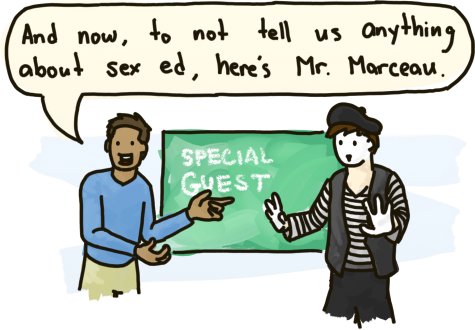
      We seem to have gotten off topic so lets get back to education. The topic of the day is how much physed is currently included in high schools. On one side of the spectrum, people argue that physed is a bird course only taken by students who want to be marked on running around and having fun, therefore physed should be excluded from the curriculum. As stated earlier I feel like this stigma could not be farther from wrong. Physed is extremely useful in two ways. Grade 9 is a critical year in students lives, puberty and all that fun stuff we've been through. It's a very confusing time for all of us, nobody like change, especially when it offers an abusive amount of hormones and acne. I think everybody knows where I'm going with this, and its the importance of sexual education. Sex Ed is a critical subject in school that is grouped together with physed. Turns out the human body doesn't come with a manual, so we need someone to teach us all about the birds and the bees, for lack of a better term. The importance of education on STD's, pregnancy, and puberty is unparalleled in a high school where students spend more time experimenting than studying. Unfortunately, I found that in my high school as well as others, sex ed was included but skimmed over because the teacher felt awkward or that it was unimportant.
http://www.slapupsidethehead.com/wp-content/media/2009/05/sex-ed-class.jpg


 How do we fix this? I don't know, I'm just a math teacher. Maybe one day when I have my own classroom I'll devote a single lesson to sexual education, partially because I think its important, but mostly because my students will be so confused and thrown off they will forever revere me for being able to throw a curve ball at them at any time.
      The second reason physed is useful is for the fitness aspect. At this time some young adults have been introduced to a life of fitness, those who have already spent years on the ice playing hockey or on the field with a soccer ball. There is also the other half of the population who are similar to me, those who know nothing about fitness, and can't even skate. If given the choice in grade 9, me and my fitness-phobic peers would never take physed, but this is why it is so important that it is so mandatory. Grade 9 physed teaches those who are unaware the importance of a healthy lifestyle. They can use this information to hopefully continue a healthy lifestyle in future years.
      Although I find physed irreplaceable, I also find it illogical to have it mandatory for all four years of high school. I believe that physed is just as important as art, history, and many other topics which are not fully mandatory in high school. So why should physed be mandatory if none of these other courses are? I believe that the only fully mandatory course in high school is English, even core subjects such as math or science do not have to be studied throughout all four years. At the end of the day the point of high school is to prepare a student for post secondary education or work. There is often little to no room for students pursuing post secondary education to take an elective that does not relate to their topic of interest. Therefore if physed is fully mandatory, so should a number of other classes. There is simply not enough room in a students schedule to take more than one or two courses which do not directly relate to their preferred field of study. If students want to take physed classes, they have the option of choosing it as their field of study or even making it an elective. Therefore even though I find physed important, I believe that it should only be mandatory in grade 9.
       Tadah! We have finally finished my blog section. The end of an era, one might call it. No one calls it that, I'm probably lying to you. Thank you for sticking with me throughout this journey blog friends, you have been great listeners. Stay golden ponyboy <3


Mark

Thursday, November 6, 2014

Integrated Curriculum

     Hello Blog friends! Long time no see, I hope all is well. We are back here today to speak about education, although I am starting to feel as though I am doing most of the speaking. I would like to talk to you today about Integrated Curriculum. Integrated Curriculum is a concept which works extremely well, but can be difficult to implement. To put shortly, The idea of integrated curriculum is to include a variety of different subjects into a single project or lesson, which accurately teaches the separate curricular material. By expressing to students the possible overlap between subjects they are able to understand the importance of each topic in a real world application as well as their relevance towards each other. The goal is that through this students will become more engaged in their education.
      An example of integrated curriculum applied in the classroom would be to have your students work on a project based on answering the question "Where is the best place in the world to live?" Obviously this question is partially opinionated so many different answers will arise. The objective is for students to research an area based on its geography, history, and several statistical based ideas to represent a variety of factors that are applicable. Through this students not only understand how these separate subjects can relate to each other but also direct their own learning withing the classroom.
      The reason that I am bringing up this topic is because I am currently doing a project based around Integrated Curriculum in my education class. This project consists of me working in a group to create a curriculum based around this concept. Through this project I have realized how difficult it is to create a large scale Integrated Curriculum, it is hardly a one man job. If schools are to implement this concept it will require a large amount of collaboration amongst their teachers, otherwise it may prove to be ineffective. There are many faults that exist within Integrated Curriculum if it is not planned well. One of these faults is the fact that some lessons may be overlooked. There are many concepts that the curriculum states is necessary for a student to know. Some of these concepts are compatible with other subjects, others are not. These concepts which may not be effective for Integrated Curriculum may be overlooked by teachers, and then the students will be unprepared when reaching higher levels of learning. Another factor that needs to be taken into account is that unless the teachers of a school are constantly in tune with each other and plan ahead, an integrated based project may become confusing and messy. It is important that teachers are consistently collaborating in order to make Integrated Curriculum effective.
    As mentioned earlier this only applies to larger scale ideas of Integrated Curriculum. There are much smaller scales that can be applied in individual classrooms, and if a school is not confident with changing their education practices this can also be effective. Examples of smaller scale ideas of Integrated Curriculum is an elementary classroom spelling a word, and then drawing a picture of that word and colouring it in. This simple activity combines art and spelling, and is extremely easy to carry out. Therefore although integrated curriculum can be a difficult accomplishment, it can prove to be very rewarding, even in the smallest of senses.


Thursday, October 9, 2014

Mostly Rambling with a Smidgen of Education Talk

       Hello again my blog friends! It has been long. Too long. I apologize for not keeping in contact, but I have spent the past two weeks drowning in my sorrows and studies (they go hand in hand). If only there was an easier way to learn...


I should just take a page out of Garfield's book (pun intended).


      How have you been? The weather is starting to get a bit brisk, don't you think? How about those Maple Leafs? Enough of the idle chit chat! We have important things to discuss and you should not be distracting me at such an important time! Shame on you blog friends. Shame on you. I don't even like the Leafs. Who am I kidding I don't even like hockey... or any physical activity now that I think about it... But there are many things to be discussed, one of which is not my laziness, so lets get this shindig started.
   
       I may have mentioned earlier that my main teachable is mathematics, and if I didn't I'm telling you now. Now I could spend the majority of this post trying to convince you that math isn't scary and that its actually a very interesting subject, but that would take the larger portion of my lifetime and I'm sure you have better things to do. The point I am trying to make here is that math is a very theoretical subject, and this is why it often comes off as dry. People care much less about a subject if they don't understand how it applies to their life, which is logical. Why should I memorize all these numbers if all I'm going to get out of it is... A mark... Which is just another number... Woohoo (insert sarcasm here). My objective as an educator is to make my subject and course material engaging, so yes, I am going to spend the larger portion of my lifetime trying to make math interesting. Our logic process thus far dictates that a good place to start is to show students that math is applicable. How to we do this? More projects, more collaboration! You guys probably thing that I am obsessed with collaboration since I bring it up so often. Well that's because collaboration is debatably the best thing that has happened to man kind since the invention of the wheel. Don't quote me on that. Point is that collaboration is in my opinion one of the most useful tools in education, and that is not something you realize until you see it first hand. I am confident that I would not be in university right now if I did not have have my classmates to collaborate with, and I know many people which feel the same way. By introducing your students to projects which require them to research a real world application, or even have your students work in a real world setting, they are able to fully explore and understand a lesson. Further use of this design is to have students lead their own learning, and come up with their own project ideas instead of the educator, this way they become emotionally invested in their task. To summarize, education would be much more effective if students were engaged in real-world based projects. Now if only a design that revolved around this idea existed... Oh wait! It does. Its called Inquiry-Based Learning. It's a thing. Look it up.

      As mentioned earlier, my life these past two weeks have consisted of homework, food, and sleep (the last one is optional). Needless to say, I have had more than enough time to reflect on my life decisions. The same life decisions that have now led me to this point of time where I am sitting on the sixth floor of the library in my socks and pajamas, for 9 hours. Strange how one week the school life is carefree and then the next the only thing keeping you awake are those 3 coffees you chugged half hour ago. I think we all have a creeping suspicion that there exists an international league of professors that meet bi-weekly to discuss how many midterms they can place on a single day before a student ends up in the mental hospital.


This is how horror movies originate. With kids who can't do algebra.

    
      All of this rambling eventually leads to a valid point, just bear with me here. So amongst my self pity and reflection I came to the conclusion that the majority of the information I am learning is utterly useless to me. Kind of sad that it took me four years to realize this actually. How is understanding the derivation of energy from a Lagrangian equation going to help me teach high schoolers how to factor? I don't want you to pull a muscle trying to find an answer, so let me give you a hint: it doesn't. But that doesn't mean that all this schooling I am going through is useless. You better put on your hardhat because I'm about to drop some knowledge on your head. Our university education is actually teaching us some very useful skills and they are doing it through the hidden curriculum. Boom, big key word over here. I'm just connecting all the dots. If there is one thing that my education is teaching me by shoving information down my throat and testing me in a confined time frame, its not formulas. It's resilience, it's time management, it's methods of stress relief and a whole slue of other phrases I could spout off all day. In short, I came across an epiphany of sorts which states that even though I may not appreciate what I am learning in school, I can appreciate the fact that it is shaping me into a character who can effectively manage and teach a classroom one day.

    This is where my ramble cuts off. I would like to formally thank you for hearing out my thought process and reading my post. And if you didn't read my post but just kinda skimmed, you're really missing out. So long blog friends. Don't ever change.


Wednesday, September 24, 2014

Backward Design


     Hello friends! It has been a long two weeks, but there is always more topics to be discussed so we are back again. Today I wanted to talk to you about a curriculum design that has always stood out to me as being effective. This is called backward design. Backward design challenges traditional methods of curriculum design and offers a more in depth lesson plan that can effectively teach a concept in a more interesting and engaging manner.  Backward design is a way of creating your course plan which is (as insinuated) the opposite compared to the traditional plan. If you haven’t heard of this before then you’re in for a treat. Let us go through the step by step process on what it means to use Backward Design. The pretext to this method is that an educator must have a thorough understanding of her students and the curriculum. The reasons for this are obvious. As I spoke about in my previous post it is extremely important that teachers do not assume that all students are the same. This is because all students are unique and therefore process information in unique ways. By understanding every student individually a teacher is able to create a lesson plan that is effective for the whole class. It is also important for teachers to understand the curriculum, because otherwise it would be very difficult to create a lesson plan based on it. 
      The first step of backwards design is to identify the KDB of the unit. We’re going to take a minute here to discuss what KDB is and why it is important to our education. KDB stands for know, do, and be. These three aspects are very important when creating a lesson. Knowing is understanding the basic knowledge required for a lesson. The information stated by the curriculum that is necessary for students to learn. It does not matter how original and interesting a lesson plan is. If it does not teach the students what is required then it is not effective. If I am running an English lesson on Shakespeare, there are many interesting activities that I can brainstorm to make his stories come to life (such as them acting it out). I can engage my students and help them understand the story. But all this is useless if I don’t teach them the deeper meaning of Shakespeare’s scripts. The student will remember that Macbeth died, but they won’t understand the lesson about the negative effects of revenge taught through this. The next step is to do. After students know this base knowledge, they can connect ideas together and do hands on projects to help the ideas sink in and gain a deeper understanding of the information and how it can be applied to a real world setting. I think that it is very important in any subject that a student understands the applications of the lesson. If you explain how certain streams of math or science can be applied in everyday life the students will be more engaged. The final step is be. This is a little more abstract than doing. Being is the skills gained from lessons and course plans, such as critical thinking, good work habits, or the importance of social issues.
      The second step in this method is to create a rich performance assessment. This strongly ties in with having a deep understanding of your students. This step requires the educator to create a form of assessment that most accurately depicts what the student has learned. Depending on the student, the assessment could be in the form of a test, a verbal presentation, or a hands on project. This evaluation should also benefit the student. By using assessment for learning, the form of evaluation can be used to progress the students knowledge of a subject and enhance his or her learning. Assessment of learning is much more effective compared to assessment of learning, because you are not simply labeling the student with a grade, but progressing him towards a goal. The final step to backwards design is to work on the daily instruction. This is where you tie in all of the previous thoughts and ideas to create a day to day lesson plan that you will present to your class. this step is about organizing all of your ideas on a subject into daily activities and manageable sizes. I believe that using this method of backwards design an educator can effectively produce a curriculum design that can benefit each and every unique student.

Wednesday, September 10, 2014

Education, technology, and pointless comments.

          Alright, now that we've been introduced lets get down to business. Education. A topic discussed over and over, and I use the word "discussed" very lightly because if there is one thing that I have learned throughout the past four years studying education, it is that there are many people with many strong opinions on such a broad subject. Consequently, when two people with two different opinions have a "discussion", it can easily turn into an argument. Needless to say it can be a touchy subject, and one that deserves to be. I think it goes without saying that education is an extremely important factor of our society. Observing from a time-based perspective, the average child spends 8 hours a day in their school, 5 times a week, for 10 months. plugging those into a calculator means that a student spends about 1680 hours a year in the hands of our educational system. Adding on to this we're not including the time someone spends on extra-curricular activities or simply working on their studies after class. While were making a point of how big this topic is, let us pile on the fact that these are children we are talking about... you know, those little things that have an infinitely large energy supply and spend the majority of their time mistaking me for a tree and hanging off my arms. I am willing to overlook all of that though, because this tiny beings have an impressive knack for absorbing everything around them. And by everything, I mean everything. I think we have all heard the reference between a child's mind and a sponge. This not only insinuates that they are exceptional at learning new information, but that the environment they are put in has a large effect on their life, and as stated earlier the average child spends a large portion of their time in the hands of our educational system. If our educational system is going to have such a large effect on a student's life it is only natural to want to make it as constructive as possible. This marks the appearance of many questions which fall upon future educators. How do we optimize the effectiveness of our education? How do we nurture our students to become critical thinkers?  to be logical people? contributing members of society? How do I cultivate the smartest doctor? the most creative artist? The most skilled engineer? And in my opinion the most important question of all, how do I ensure that my students have a future in which they are happy? I don't know the answer to any of these, I'm just some random university student trying to scrape by. What I am hoping for is that throughout this blog we will come closer to solving these issues.

         Lets get started shall we? There is no time to waste. It is impossible to critique our educational system without analyzing the backbone of schooling itself, curriculum. There are many different forms of curriculum, the most obvious one being the formal curriculum. Formal curriculum is the information in the provincial ministry of education documents as well as the course syllabi. It is what tells the educator that their first grade class will be learning addition instead of quantum physics. Formal curriculum is an important aspect of our education because it ensures that all students who graduate from the same year share the same essential knowledge for them to effectively further their studies, as well as be able to function in society. As an example, being able to add is a pretty handy skill to have in every day life, although 5 year old Mark will probably think otherwise. This is why  it is a good thing that (1) everyone knows how to add, and (2) somebody more qualified than I is determining what essential knowledge is. The second form of curriculum is informal Curriculum. This includes the knowledge, skills, and attitudes that are gained through extra-curricular activities as well as other activities that occur outside of school. I am a strong believer that extra-curricular activities are a great way to gain social skills, teamwork skills, self esteem, and many other positive characteristics. Informal Curriculum is very well thought through in our education system, there are activities for everybody from sports teams to drama clubs to game meetings (I was always part of the later two). The third form of curriculum, as well as the least obvious (as insinuated by its name) is the hidden curriculum. Hidden curriculum is considered a sort of side effect of education. It is the social norms, values and beliefs that are conveyed unintentionally through both the instructor and the educational environment. These beliefs often reflect the status quo and are often widely accepted in the societal context. Unfortunately the hidden curriculum has the ability to reproduced undesirable behaviors, a common example of which is bullying. Luckily, if considered the hidden curriculum can also be used to promote positive behaviors and create a safe work environment.

      Moving on from the general picture there are also specific models of curriculum, the most commonly known of which is our traditional curriculum. We all know what this is because we have all experienced it. The classic classroom situation where the educator stands at the front of the class while his or her students sit there quietly and accept the information being poured into their heads. Along with this comes standardized testing, one general form of assessment that is said to fairly grade all students. Contrary to this belief it is also well known that every person processes and outputs information differently, so how is it logical that one general form of assessment can judge how much a student has improved intellectually over the course of a year? I'm sure we all know that one friend who can stand up in front of his peers and express his ideas extremely well verbally, but push a pen and paper on his desk and he'll spend the next hour staring out the window. Is it then accurate for his teacher to pick up the blank page and assume it reflects what is happening inside his head? Of course not. But that is currently how our education system runs. Fortunately there are other models of curriculum which are more effective, a personal favourite of mine being project based learning. This model includes learning the formal education through a hands on approach, by working on projects in groups which relate to the course material. This provides the opportunity for children to collaborate with each other and create a physical result of the course material. I believe that there is no better way to understand course material than to discover it yourself, instead of being told the answers by the teacher. Project based learning provides an opportunity for students to discover the lesson themselves.

     The last thing that I want to talk about with you today is technology. The use of technology in our everyday life has increased drastically over time. With the increased popularity of computers, phones, ipads and many other devices over the past decade or two, it is only natural that our education board would to discuss using technology within the classroom to promote learning. After all, children at younger and younger ages are wanting to use their cellphones in class, so why not make it beneficial? This concept of using technology in class includes doing projects on computers, having smart boards within the classroom, and even including phones in everyday lessons. I believe that it can be very beneficial, but at the same time it is important to approach this issue very cautiously because when you bring technology into the classroom you also bring many distractions with it as well. If students are to be on their phones in class, educators need to find a way to make sure its for educational purposes and not playing on their applications. This is obviously much easier said than done, considering students have an impressive ability to find distractions in anything and everything while in class. I mean, I had a pen and paper in front of me and hour ago that were meant solely for educational purposes, yet somehow I find myself drawing abusive amounts of stick figures in class instead of writing down Euclid's axioms. This was not because I do not enjoy Euclid's axioms, they are quite a thrilling set of rules and I'm sure that Euclid was a swell human being that doesn't deserve to be overlooked due to a doodle. I simply did not feel involved in the lesson. To reiterate what I have already said I am a firm believer that in order to create an effective classroom an educator has to promote collaboration, engage your students, and utilize technology.

Monday, September 8, 2014

Introductions and Formalities

Hi,


My name is Mark and this is the place where I write things that I think. I don't think I've ever actually seen a blog until the previous half hour of my life, so I'm still trying to wrap my head around what the concept of this whole page is. One thing I have realized is that having a blog means that it is an opportunity for me to be as self centered as I want, because lets be real, who here is going to stop me?... nobody...? that's what I thought. Anyways as part of an introduction of myself I should explain that the reason this blog exists is for me to express my thoughts and reflections on an education course of which I am a part of, as you will soon find out. Just as well I feel it is necessary to explain to you just how technologically illiterate I am, considering it took me the larger portion of an hour just to sign up for this thing. Therefore I apologize in advance for the poor nature of my blogging page, as well as any formalities of blogging that I am unaware of. And there it is, I have officially made my first post on my blog! A large milestone in my life hopefully followed by many more. I will spend the next half hour attempting to figure out how to post a picture of a puppy such that reading this paragraph wasn't a complete waste of time for you. Until next time, farewell from Mark and Mr. Fluffles.


Mr. Fluffles